“"Many used car dealers want to buy a batch of cars before December 31st and then register them for export," said Wang Bin, a used car dealer in Hebei. He explained that vehicles that have already completed the registration process before January 1st of next year can still apply for export licenses.
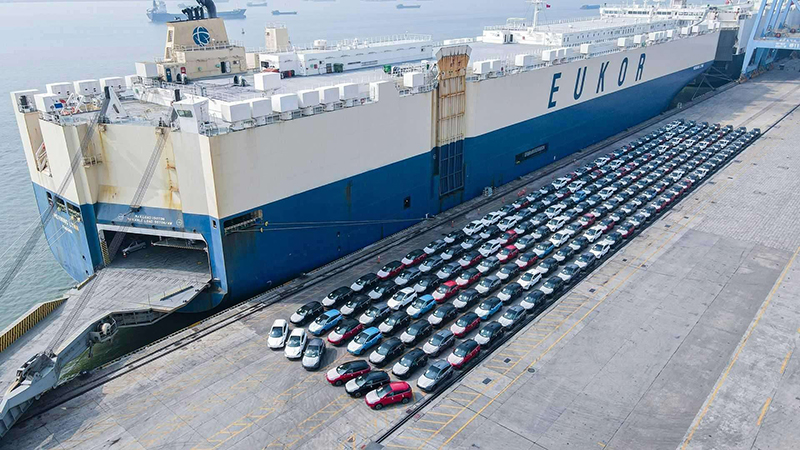
The hoarding of new cars by used car dealers is related to the recently introduced new policy on used car exports. On November 11, 2025, the Ministry of Commerce, the Ministry of Industry and Information Technology, the Ministry of Public Security, and the General Administration of Customs jointly issued the "Notice on Further Strengthening the Management of Used Car Exports" (hereinafter referred to as the "Notice"), which strictly controls the export of new cars under the guise of used cars.
Exporting new cars as used cars has been an unspoken rule in the automotive export industry for the past two years, with a large number of "zero-kilometer used cars" being sold overseas. "According to the new policy, in the future, only OEMs and their 'authorized exporters' will be able to export zero-kilometer new cars," said Wang Bin. Therefore, most car dealers engaged in the used car export trade can only honestly deal in genuine used cars, and the current practice of stockpiling cars is not the right solution.
“"2025 can be considered the first year of Chinese used cars going global." Liu Hua, a used car dealer in Hebei, believes that on the one hand, new cars will return to the OEM and authorized dealer system in the future, and the chaos of "zero-kilometer used cars" will gradually disappear; on the other hand, the new policy will prompt car companies and used car traders to increase investment in overseas services and improve the parts supply chain, ultimately leading to high-quality development.
Half of used car exporters will be eliminated.
“"The new policy on used car exports starting next year will reshape the industry. The 'After-Sales Service Confirmation Certificate' alone will block those who want to 'reverse the tide' (referring to those who modify their vehicles)," said Wang Bin. He added that some people still think they can go down the modification route, but Appendix Two of the document, "Requirements for the Authenticity of Modifications," requires genuine modifications, like modifying a Mercedes into a Brabus. The "Notice" is mainly divided into three parts: First, further tightening the management of used car exports. The most important part is strictly controlling the export of new cars under the guise of used cars. Starting next year, for vehicles applying for export that are less than 180 days (including 180 days) from the registration date, local commerce departments will guide local enterprises to submit a "After-Sales Service Confirmation Certificate" issued by the vehicle manufacturer.
Second, compliance reviews will be further strengthened, and the licensing conditions for vehicles exported under the guise of modified vehicles will be strictly enforced. Enterprises exporting modified vehicles must fill in information such as the vehicle chassis brand, the modified vehicle brand, and the vehicle model, and submit supporting documentation proving the authenticity of the modification. Export licenses will not be issued for products whose authenticity cannot be proven, whose similar modified vehicle products are not listed in the "Announcement of Road Motor Vehicle Manufacturers and Products," or whose products lack valid national mandatory product certification.
The notice was issued against the backdrop of "zero-kilometer used cars" becoming a major force in automobile exports, causing chaos in the export market. An official from the China Automobile Dealers Association revealed to the Economic Observer in 2024 that over 901,0 ...
These "pseudo-used cars," which have completed registration but have extremely low actual mileage and are in no different from new cars, are being exported by some companies through the "registration and export" operation. This allows them to circumvent the technical certification and high tariffs required for new car exports, thereby obtaining export tax rebates of up to 13% and local subsidies, while also impacting overseas markets with prices lower than those of regular new cars, which range from 15% to 40%.
“There are about 3,000 used car dealers exporting used cars nationwide, and it is estimated that at least half of them will be eliminated next year,” Huang Ruoyu, president of the Used Car Export Branch of the China Automobile Dealers Association and secretary-general of the Sichuan Used Car Dealers Association, told the Economic Observer. He added that small traders, individual used car dealers, small team used car dealers, and used car dealers who rely on government policies but do not understand the car market will likely be eliminated next year.
The notice emphasizes the need to establish a dynamic management and exit mechanism for enterprises. Local commerce departments should strengthen the construction of local used car export credit evaluation systems, conduct daily supervision and dynamic management in accordance with the "Negative List of Dishonest Behaviors in Used Car Exports," and regulate enterprise business practices and export competition.
“Since 2019, most of us have been using our used car licenses to export new cars for five or six years,” Liu Hua said. “Next year will be the year to return to the real used car export business.”
Used car exports will face short-term pain.
Since 2019, China's annual used car exports have surged from less than 3,000 vehicles to 436,000 vehicles in 2024, an increase of over 145 times. This rapid growth may see a turning point next year. "The new policy on used car exports is a good thing for the industry, but in the short term, there will definitely be growing pains. Any reform will harm the interests of some people," a relevant official from the China Association of Automobile Manufacturers told the Economic Observer. "With such a large proportion of 'zero-kilometer used cars,' used car sales next year are likely to decline, at least initially at the beginning of the policy's implementation."“
Huang Ruoyu told the Economic Observer, "We expect the total export volume of 'zero-kilometer used cars' to reach about 450,000 vehicles this year." He recently stated at the China Automobile Circulation Industry Annual Conference and Expo that China's used car exports are expected to exceed 600,000 vehicles by 2025, with the Southeast Asian market accounting for more than 50% of the total.
However, Huang Ruoyu predicts that used car exports will still rise next year. He believes that firstly, the demand for used cars in overseas markets remains large, especially in countries and regions such as Russia, Central Asia, and Africa, where cars are still in short supply; secondly, Chinese used cars are still highly competitive overseas in terms of both product quality and price.
Wang Bin believes that the "zero-kilometer used car" policy only restricts smaller used car dealers, and this avenue is not completely blocked. The new policy effectively reclaims the export rights of new cars from OEMs; export companies can still export as long as they have the OEM's "After-Sales Service Confirmation." As long as there is inventory, larger authorized used car exporters with ties to OEMs will still have the opportunity to export "zero-kilometer used cars."
On November 30th, the China Automobile Dealers Association released its latest "China Automobile Dealer Inventory Warning Index Survey" (VIA), showing that the inventory warning index for November 2025 was 55.6%, up 3.8 percentage points year-on-year and 3.0 percentage points month-on-month. The inventory warning index remains above the boom-bust line, indicating a slight decline in the prosperity of the automobile distribution industry.
Liu Hua believes that with policies encouraging the export of used cars in the past two years, coupled with a large supply of high-quality vehicles brought about by the replacement of National VI emission standard models, China's used car exports will continue to grow in the medium to long term, mainly flowing to markets in Asia, Africa and Latin America where there is demand, because those markets have neither emission requirements nor scrapping systems.
Since February 2024, the management of used car exports has changed from a "pilot approval system" to a "national registration system," which has become a direct policy driver for the surge in used car exports, with over 2,000 used car companies entering the market nationwide. Now, with the increase in irregularities in the export of "zero-kilometer used cars," policies are becoming stricter. However, overall, while policies encourage used car exports, high-quality development is the ultimate goal.
Used car exports need to transform and upgrade
“The export of ‘zero-kilometer used cars” is a one-off transaction. These cars have no warranty, so the more they are sold, the worse the reputation of domestic brands in overseas markets will become,“ Wang Meng, an expert from the China Automobile Dealers Association and a veteran in the used car industry, told the Economic Observer. Article 3 of the ”Notice” proposes to continuously promote the healthy development of used car exports and enhance the international operating capabilities of enterprises. It encourages qualified enterprises to establish public display and trading markets in key markets and expand comprehensive services such as marketing and warehousing; improve the export support system; guide export enterprises to work with automobile manufacturers and overseas importers to provide after-sales service; promote exchanges and cooperation between export enterprises and supply chain supporting enterprises such as logistics, finance, and third-party warranty agencies; and carry out “one-stop” services such as used car export preparation, inspection, customs declaration, and logistics.
“"Actually, the policy has two strategic intentions. The first is to avoid China's used car exports from repeating the mistakes of domestically produced motorcycle exports in the 1990s. It is not easy for China's automobile industry to develop from backwardness to global leadership," Huang Ruoyu said. Used car exports are only a few hundred thousand vehicles, while new car exports have reached 6.8 million vehicles. Used cars are just a drop in the ocean compared to new cars. The "zero-kilometer used cars" should not affect the overall automobile exports.
The aforementioned official from the China Association of Automobile Manufacturers also stated that in the past, some automakers disguised new cars as used cars for export in order to boost sales, which disrupted overseas markets and damaged the country's reputation. Now, the policy clearly states that the industry has entered an era of "high barriers to entry + high quality + high service," and Chinese automobiles must shift from "massive sales volume" to "high-quality global competition," with low-quality exports being systematically eliminated.
Against this backdrop, the Chinese auto industry needs to evolve from "selling price differences" to "selling services and the entire industry chain," with parts, repairs, and after-sales service being the key value drivers to be encouraged in the future. "Currently, what Russia, Central Asia, and Eastern Europe lacks most is not cars, but long-term stable supply, after-sales service, and parts. What we need to do is provide service value, long-term value, and compliance value," said Liu Hua.
Liu Hua believes that the new policy on used cars is not simply a "tightening" measure, but rather an "upgrading and leapfrogging" strategy. There is a huge demand for used cars in overseas markets such as the Middle East and Africa, and China has the opportunity to replace Japan as the largest used car exporter in Africa.
“"The second strategic intention is to solve the infighting in the domestic car market and thus promote domestic new car consumption," Huang Ruoyu said. "Only by selling domestic used cars overseas and solving the problem of oversupply in the domestic market can we stabilize used car prices, thereby stabilizing domestic new car prices and promoting domestic consumption. Japan and South Korea have followed this path before, and China still has a long way to go."”
 简体中文 简体中文
  English
 Русский
