Recently, the Ministry of Commerce, the Ministry of Industry and Information Technology, the Ministry of Public Security, and the General Administration of Customs jointly issued the "Notice on Further Strengthening the Management of Used Car Exports" (hereinafter referred to as the "Notice"). The core measure of this Notice, which is vividly referred to in the industry as the "180-day red line," aims to thoroughly rectify the chaotic situation of "zero-kilometer used car" exports that have long operated in a gray area.
Industry insiders believe the issuance of the "Notice" is not accidental. China's used car exports surged from 4,300 units in 2020 to 436,000 units in 2024—a more than 100-fold increase in six years—supported by the "zero-kilometer used car" export model, which had long operated in a gray area. Now, a profound reshuffling themed around "standardization" and "value" has begun, and the entire industry chain will have to redefine its position in this transformation.
Targeted rectification of the chaos surrounding "zero-kilometer used cars"
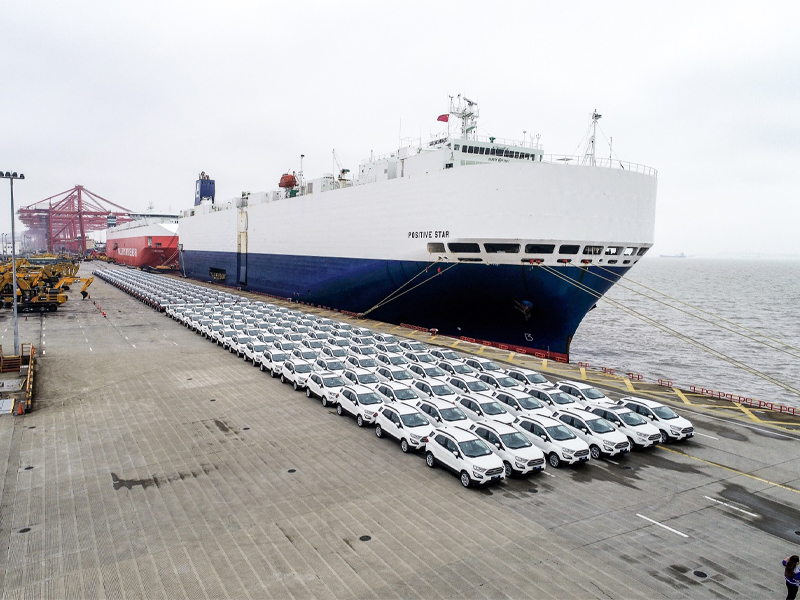
The most authoritative clause in this notice is the so-called "180-day red line" rule. The notice clarifies that, starting January 1, 2026, for vehicles applying for export that are less than 180 days old from their registration date, local commerce authorities must require companies to submit a "Confirmation of After-Sales Service" issued by the vehicle manufacturer. This confirmation must detail the country of export, vehicle information, and after-sales service network information. Vehicles unable to provide this confirmation will not be issued export licenses.
“"This regulation directly hits the nail on the head regarding the current state of the industry," automotive industry observer Zhao Yongqi told the China Times. He explained that the new regulation requires a manufacturer's certificate, which is simply unavailable to ordinary used car dealers. Therefore, starting in 2026, the business of buying and selling "zero-kilometer used cars" will become unsustainable.
A professional in the used car business in South China revealed the operating mechanism to reporters: "Some OEMs' major account departments have sufficient authority and profit margins to provide sales channels outside the dealer system. For example, a newly opened car rental company wants to purchase a large number of vehicles, but due to various reasons, the transaction cannot continue. These customized new cars will then be resold at a price no less than the cost price." This operation is known in the industry as "vehicles with license plates and taxes included." In essence, they are still new cars, but they are circulated under the guise of used cars.
Furthermore, Wei Jianjun, chairman of Great Wall Motors, has publicly criticized this chaotic phenomenon, pointing out: "There is a strange phenomenon now called zero-kilometer used cars. That is to say, a new car is registered as soon as it gets a license plate, and on the surface it seems to have been sold, but in reality it has become a used car. How can a used car be zero kilometers? It has only been registered. In other words, zero-kilometer used cars are a kind of chaotic phenomenon in themselves."“
While sales have increased in the short term, the influx of a large number of "zero-kilometer used cars" into overseas markets at low prices has severely impacted the new car pricing system established by Chinese OEMs through legitimate channels. The more far-reaching harm lies in the lack of after-sales service. "Due to the lack of a comprehensive after-sales service system, and the fact that some vehicles are sold overseas through low-price competition, disrupting the market order, this could potentially backfire on the overall reputation of Chinese auto exports," Zhao Yongqi added.
In addition to the core "180-day" clause, the "Notice" also presents a systematic solution that combines "blocking" and "guiding." It further strengthens the standardized application and issuance of export licenses, requiring that information be submitted truthfully and accurately, and will establish a dynamic management and exit mechanism for enterprises. The document also simultaneously released a "Negative List of Dishonest Behaviors in Used Car Exports," listing seven violations, including providing false vehicle information and failing to conduct export business in accordance with regulations.
It is worth noting that the "Notice" imposes stricter requirements on the export of modified vehicles. It requires companies exporting modified vehicles to accurately fill in information such as the vehicle chassis brand and the brand of the modified vehicle, and to submit proof of the authenticity of the modification. Export licenses will not be issued for products that cannot prove the authenticity of the modification, are not listed in the Ministry of Industry and Information Technology's "Announcement of Road Motor Vehicle Manufacturers and Products," or do not possess valid national mandatory product certification.
While strengthening supervision, the "Notice" did not neglect guidance and support for the industry. It encourages enterprises to explore diversified markets, supports the establishment of public exhibition and trading centers in key overseas markets; guides export enterprises to work with automobile manufacturers and overseas importers to build a stable after-sales service system; and explores the development of a "one-stop" service market for used car exports that integrates testing, preparation, customs declaration, and logistics.
The China Automobile Dealers Association commented that this plan is not simply "restrictive regulation," but a systematic plan that promotes healthy development through "guidance." It not only sets clear industry bottom lines by defining clear rules to encourage companies to strengthen self-discipline, but also promotes "compliance and quality improvement" across the entire industry through supporting measures, clearing obstacles for my country's used car exports to move from "scale growth" to "value growth."
The return of value after the growing pains
The introduction of the new policy will undoubtedly trigger a profound restructuring of the entire industry chain and a fundamental shift in the competitive landscape. Short-term pain is inevitable, but in the long run, this is an essential path for the industry to mature from its initial chaotic state and move from disorder to standardization.
The most direct impact will be a major reshuffle of the industry, with many small and medium-sized used car exporters lacking resources and support from OEMs facing a severe survival test. Zhao Yongqi pointed out: "There are hundreds of thousands of used car dealers nationwide, among which a considerable number specialize in 'zero-kilometer used cars.' After the implementation of the new regulations, these companies will either have to transform or exit the market."“
Chen Haifeng, president of the Used Car Export Branch of the All-China Federation of Automobile Dealers, stated that the timing and content of the "Notice" were in line with industry expectations, and provided companies with a buffer period of about one and a half months. The policy's initial intention was to allow used car exports to return to the old car export model, while new car exports would be implemented according to the existing automaker authorization management system, thereby achieving classified management, complementary advantages, industrial cooperation, and overseas network collaboration between used car exports and new car exports.
At the same time, clear rules will prompt all parties in the industry chain to reposition themselves and form a new pattern of professional division of labor. "In the long run, the policy is also a major benefit to the used car export industry, which will guide the market into healthy competition," Zhao Yongqi analyzed. "OEMs and their dealers and used car companies will each perform their own duties, and each will separately carry out the export business of new cars and 'zero-kilometer used cars' and 'long-kilometer used cars'."“
For OEMs and their authorized dealers, they will become the "legitimate force" in the export of "nearly new cars," as they are currently the only entities capable of issuing "After-Sales Service Confirmation Certificates." This will enable them to legitimately establish comprehensive sales and after-sales systems in overseas markets, safeguarding brand value and long-term interests.
For professional used car export companies, policy guidance will force them to completely shift their business focus to overseas markets for genuine, long-mileage used cars with proven use. This will compel companies to deepen their core capabilities in areas such as vehicle inspection, value assessment, and personalized preparation, establish transparent and reliable vehicle condition information traceability systems, and focus on tapping the value potential of used cars of different ages and grades in diversified overseas markets.
Cui Dongshu, Secretary-General of the China Passenger Car Association, pointed out: "The new policy requires companies to provide third-party testing, electronic repair records, and declarations of access to the destination country, strengthens full-process traceability and credit management, and forces companies to focus on service upgrades—improving overseas repair networks, spare parts supply and warranty commitments, and promoting the industry to shift from 'competing on price' to 'competing on quality and service'."“
Cui Dongshu further analyzed the positive impact of the new policy on the overall situation: "For new cars, strictly distinguishing between new and old standards and improving the transparency of vehicle conditions not only maintains a reasonable premium for new car exports but also prevents used cars from impacting the image of overseas new car markets by being presented as 'low-priced new goods.'" He believes that in the long run, a standardized and reliable supply of used cars will optimize the supply and demand structure of overseas markets, help Chinese automobiles (including new cars) establish an international brand recognition of "high cost-performance + reliable service," build a more orderly global competitive environment, and lay a solid foundation for China's automobile exports to exceed 10 million units.
Furthermore, the new policy will have a wider ripple effect. For overseas consumers, they will say goodbye to the "one-off" consumer experience. Whether it's a nearly new car purchased through OEM channels or a "long-mileage used car" from a professional used car dealer, their after-sales rights will be better protected, which will help build long-term trust.
“"The growing pains are the price of transformation, but after the transformation comes a new life." Zhao Yongqi said that when "zero-kilometer used cars" become history, and when the industry's competition returns to the track of integrity, quality and service, the ship of China's used car exports will truly be on the right track and sail towards a more resilient, sustainable and valuable blue ocean.
 简体中文 简体中文
  English
 Русский
